

Driving in Sardinia is a fantastic experience, and as a local I wholeheartedly recommend it.
Sardinia is a great place for road trip lovers and there are some great scenic roads on the island. In fact, the best way to get around the island is by car, especially to reach certain places on the coast or inland.
In addition, with a car, you can better organize your stops and follow your own timetable, without having to worry about missing the scheduled bus or train (public transport in Sardinia isn’t exactly the best). A slow and relaxed driving pace is perfect to enjoy and take in the natural beauty of the island.
However, before you get behind the wheel in Sardinia, it is good to know a few things so you can drive around Sardinia with peace of mind and know what to expect.
I am a local, and I love driving in Sardinia (I actually enjoy driving in general!), and I am ready to share all the secret that will help you make your road trip around Sardinia absolutely memorable. With my Sardinia driving tips you can rest assured you will have a smooth trip.
In this guide you will find all the information you need about driving in Sardinia and the general condition of the roads.
Make sure to rent a car for your Sardinia trip. I recommend using Discover Cars to compare the prices of car rental on the island, and read my post A Complete Guide To Renting A Car In Sardinia for all the best tips into landing a great car rental.
Not convinced you should rent a car? Then read my guide on How To Get Around In Sardinia.

Is It Safe To Drive In Sardinia?
Your first worry about driving in Sardinia will likely be one about safety.
Driving in Sardinia is usually safe. Compared to the rest of Italy, Sardinia has very low population density which means that the road are not nearly as congested as you would experience in other parts of the country (for example Rome, Naples or Milan).
This is especially true if you visit Sardinia in the off season, between October and May, when there are very few tourists. Traffic outside of the cities is typically minimal then, unless there are some celebrations of sorts (for example, roads in Sardinia can be very busy on Easter Monday, when literally all locals go for hikes, picnics and the like).
Minimal traffic means more safety.
If you decide to visit Sardinia in the summer, on the other hand, you should be prepared for traffic. In the summer time, Sardinians who work in the peninsula or abroad usually return home for their holidays. Also, as you can imagine, there are lots of tourist who visit the island.
Want some extra help planning? I’m here for you
E-newsletter
Get free weekly updates straight in your inbox.
Travel Guides
From daily activities to hotels and restaurants, my digital guides make planning your Sardinia trip easy.
Travel Consults
Book a one-2-one call to help plan your Sardinia trip
And since the car is the best way to get around Sardinia, there is always traffic in summer, both in the big cities and on the freeways.
One thing that slows down traffic is the presence of large camper-vans, which are generally a bit slower than cars. Oftentimes, the narrow and windy roads of Sardinia make it impossible to overtake them safely, so this is a thing to consider if you are worried about the safety of driving around the island.
In addition, there are many people who prefer to travel by motorbike or bike, so be very careful especially if you are not used to driving in places with lots of motorbike traffic or bike lanes.

Things To Know Before Driving In Sardinia
What side of the road do they drive in Sardinia?
This is a key thing to know before you start driving around Sardinia! Here, like in the rest of Italy and continental Europe, we drive on the right side of the road.
If you are coming from North America or continental Europe, it will be exactly like driving at home. On the other hand, if you are coming from the United Kingdom, Ireland, Australia or South Africa, you will have to drive on the opposite side of the road from what you are used to.
Legal age for driving in Sardinia
The legal age to drive in Sardinia is the same as in the rest of Italy: you need to be at least 18 years old.
What documents are needed to drive in Sardinia?
Like in the rest of Italy, in order to drive on the island you will need a valid driver’s license. If you are coming from any of the other European Union countries, your regular driver’s license will be perfectly fine.
Otherwise, an International Driving Permit (IDP) will be needed. You may or may not be asked for it when picking up your car rental in Sardinia, and chances are you will not be stopped by the police while driving around the island, but this is nevertheless a legal requirement.

You need to have insurance to drive in Sardinia
All cars circulating in Italy must have insurance. Rental car companies usually offer basic insurance, but for peace of mind I recommend getting Discover Cars Full Coverage insurance so that you have more coverage.
Speed limits in Sardinia
Speed limits in Sardinia change frequently, and you need to keep an eye on the road for signs that point out what the limit is, and for speed cameras.
The speed limit in cities is usually 50 km/h, though there are some areas within cities (usually the historic center, or areas where there are schools and hospitals) where the limit is 30 km/h. The speed limit is 30 km/h in all of Olbia municipality.
Outside urban areas the speed limit varies, and depends on the road. It can be just 50 km/h on narrow country roads, but it can go up to 70 or even 90 km/h on provincial (marked as Strada Provinciale or SP in Italian) or state roads ((marked as Strada Statale or SS in Italian).
The limit increases to 110 km/h on the freeway. There are no highways (autostrade) in Sardinia.
Locals can often be seen driving well above the speed limit. Don’t do that! First of all, it is dangerous. There are awful intersections even on the freeway, and there are good reasons why the speed limits are kept low.
Secondly, there often are speed cameras and police checkpoints, and while the locals know where the cameras are placed (and still get fines on a regular basis) you won’t. The last thing you want is to go back home with lots of souvenirs and a fine for going over the speed limit.

Wear your seatbelts!
By Italian law, all passengers in the car must wear their seatbelts. Some locals still pretend not to know it is mandatory to wear seatbelts while sitting at the back of the car – but if the police stops you, it will fine you for not wearing them.
Road conditions in Sardinia
The condition of the roads in Sardinia can vary by location, but in general road maintenance is not the best. Some roads may have potholes and depressions, often unmarked, so it’s better to drive slowly in order to avoid to damage the wheels and the suspensions of your vehicle.
Watch out for curves, too: many small roads in Sardinia have sharp curves that you need to take slowly, keeping an eye for cars coming in the opposite direction.
In the rural areas of the island there are plenty of unpaved roads. You can drive on those roads with most cars and you won’t need to rent a SUV or crossover car, but a car with a very low engine won’t do well on those.

Get used to windy and hilly roads
The island of Sardinia is quite mountainous, and the roads reflect this – there are lots of steep uphill or downhill roads, and plenty of windy roads too – a friend of mine a few years back swore to me as we were driving around the island that he was sure there were no straight roads here.
Therefore, when facing a hill or mountain road, it is best to drive slowly. Also, be careful when taking turns and curves.
There are no toll roads in Sardinia
I have come across sites that suggest there are toll roads in Sardinia. I have lived here most of my life, and I drive around on a regular basis and I have never found a toll road.
In fact, there are no highways in Sardinia, only freeways. This will spare you the toll costs, but on the other hand it will not give you many alternatives to reach certain places, especially in heavy traffic situations.

But there are lots of roundabouts
What we lack in highways, we make up for in roundabouts. There are plenty of roundabouts in Sardinia, and while this is something we are very used to in Europe, you may not be accustomed to them if you are coming from North America or Australia.
In roundabouts in Italy, you always have to give way to anyone coming from your left. The idea is that you don’t need to stop entirely (unless there is a sign that says so) but just slow down as you keep an eye on the road to make sure nobody is coming from your left.
Keep your headlights on outside of cities
This is another legal requirement in Italy: no matter the time of day, you need to turn your headlights on as soon as you get out of any urban center, whether you are driving on a freeway or country road.

Don’t fully trust road signs
Beware of road signs in Sardinia, especially in rural areas. Many signs in Sardinia are not updated, so you may find incorrect directions, and at times no directions at all. It’s not uncommon for a road sign to be placed right at the intersection you need to take, so they are easy to miss. All the more reason to drive slowly and follow your GPS directions carefully.
Use a navigation system
Speaking of the inaccurate roadsigns, or the lack thereof, you will be significantly better off renting a car that has a GPS, or using Google Maps or another navigation system on your smartphone and connecting it to your car for directions.
However, keep in mind that navigation apps generally recommend the shortest roads – which are not necessarily the best or easiest to follow. Before setting to follow the directions of your GPS, make sure to check for the various ways to get to your destination and pick the one that seems to be the easiest / most straightforward.
Also keep in mind that navigation systems may not be perfectly updated. I once used my GPS to reach a church in northern Sardinia and the GPS sent me on a quest along a completely isolated road and eventually led me on an unpaved country road which was closed down by roadworks. It took the help of a local passersby to get out of there!
Don’t get frustrated if people tailgate you – allow them to overtake
Most drivers in Sardinia are fairly respectful and not aggressive, so you are unlikely to have issues. However, you will at times notice that some drivers do not respect the safe distance. This is certainly true in urban areas, but also outside of cities when drivers want to overtake.
Some roads in Sardinia are very narrow, but that won’t stop some drivers from tailgating you. Try not to get anxious if they do, and at the first opportunity you have, allow them to overtake. In general, drive defensively.
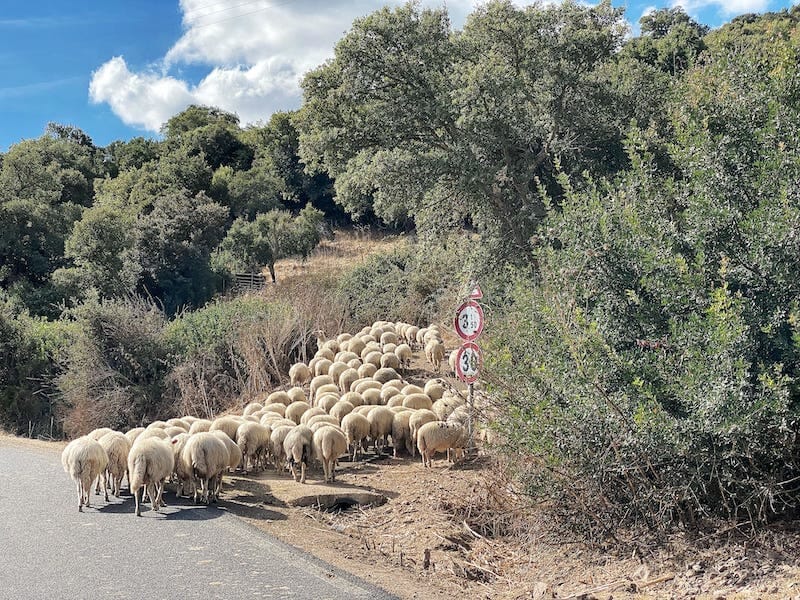
You may encounter herds of sheep in rural Sardinia
In the rural parts of the island you may come across flocks of sheep. It happened to me while I was driving from Alghero to Laconi with a friend, and more recently another friend and I were delayed by a heard of sheep as we drove from Su Nuraxi to the Giara Plateau. In fact, I recently got stopped by a herd of cows on the way to a hike!
Therefore, it is good to maintain a moderate speed on country roads, even when there is no traffic, as you never know what animals may be on the road.
In case the road is occupied by a flock, wait for its passage quietly and don’t blow the horn as this may stress the animals. There will always be a shepherd (and dogs) nearby to make sure the animals cross safely, so don’t worry!
Occasionally, herds of sheep can be seen in the city too. It should not happen, but I regularly see the same herd of sheep in the outer areas of Cagliari, sometimes even very close to where my parents live. It’s a herd of sheep belonging to a shepherd that keeps ignoring the law despite many fines.

Only park where it is permitted
There are different parking spots in Sardinia and Italy, distinguished by different colored stripes.
Blue stripes are the paid parking spots, where you can park by paying a hourly and at times a daily fee. The cost varies depending on where you are – it can go from €0.50 cents or €1 for an hour parking in the city, to €2 per hour near a beach.
White stripes are used for the free parking spots, while the yellow lines are used for parking spots that are specific for certain special categories such as disabled people, police, service cars and vehicles with special permits.
One thing that is common in Sardinian and Italian cities is what we know as “parcheggio in doppia fila”. There is a row where cars can park, and yet many people leave their car unattended in a second row that is meant for flowing traffic. Not only this is not allowed (and yet happens), but the inevitable effect is that they slow down traffic. I find it terribly aggravating!
You may also find cars parked on yellow lines without a permit, or on blue lines without paying.
Keep in mind though that you can get fined by parking on the blue stripes zones without paying, or on the yellow parking zones without a special permit. On the yellow parking zones, you can also get your vehicle towed.
If you park your car on narrow streets (for example in the historic center), I recommend to fold the rear-view mirrors, so as to avoid damage by other passing vehicles.
Finally, before visiting a particular place outside the cities, it is best to check the itinerary, to see if there is parking nearby. Most beaches have a dedicated parking area, but if you visit in the peak summer months parking may be limited and if you park where you are not supposed to, you are very likely going to get a parking ticket!

Watch out for ZTL
ZTL (Zona Traffico Limitato) is a restricted traffic zone, and there is one in almost every city in Sardinia and Italy. The ZTL is usually limited to the historic city center, it is well marked and there are traffic cameras placed near the main access points.
Cagliari for example has six ZTLs, which cover a good portion of the historic center.
ZTLs can be active on different days and specific time slots that may vary from city to city. Entering a ZTL without a permit will result in a rather hefty fine, so if you want to visit a city it is best to check both the placement of the ZTLs and the times they are activated.
This site offers up-to-date information on the ZTLs areas in Sardinia. You just need to input the name of the town or city you have to visit in the search bar and it will pull out the information you need.
When it comes to parking in a ZTL area, I do not recommend it. Parking there is usually very limited and the roads are so narrow that driving there is simply not pleasant. I try to avoid it if I can. It is best to park your car in an area adjacent to the historic city center and then move around on foot or by public transportation.

Alcohol limit when driving in Sardinia
As a general rule, I recommend not to drink alcohol whenever you are driving in Sardinia (and anywhere else in the world). In any case, the blood alcohol limit in Italy is 0.05% – depending on your body weight, what you eat and what you drink is very easy to go over!
Don’t talk on the phone
Once again, this is a general rule and it doesn’t just apply to driving in Sardinia. You should only talk on the phone if your car has a hands off device – it is fairly easy to connect your phone to the car via their bluetooth system, but in case you are unable to just pull over to the side of the road, where it is safe, if you need to make an urgent phone call.
What to do if you have an accident in Sardinia
The number to call for emergencies in Sardinia is 112 – that’s the number to call for health-related emergencies, for the police, for the firefighters etc. It’s free to call for all, even if you don’t have a SIM card at all.
Pin It For Later!



One road you REALLY want to avoid is the one that from Baunei goes to the Golgo Plateau where the hikes to beaches like Cala Goloritzé depart from. I am not afraid of heights, but I admit that’s pretty scary!
Hello Lorraine, most roads in Sardinia will have guardrails. However, I can tell you for sure that the road that connects Alghero to Bosa and the one that goes to Nebida goes along a cliff. The views are amazing, but I am not afraid of heights so I can’t appreciate your fear. With regards to the road from Alghero to Bosa, there are various routes you can take to get there so you can avoid the super panoramic way which you may find scary. There are no alternative ways to Nebida. Hope this helps!
We are visiting for 2 weeks and plan to driving around the island from Cagliari to Olbia with stops in Pula, Chia, Teulada, Nebida, Sant’Anticoco, Cabras, Bosa, Alghrro, Stintino, Santa Teresa, La Madeedelena, visiting beaches along the way. I am afraid of heights including a road along a steep cliff especially without guardrails. Are any roads along the route I mentioned a concern?
It depends. Everything is well lit in towns and cities and nearby, but it can get really dark once you get out.
Hi Claudia,
I’m so grateful for the information you’ve provided here and in all your other posts! My wife and I will be visiting for 1 week as our Honeymoon the last week of September next month and I’m wondering, are the streets well lit at night? Or do the roads become pitch black after the sun goes down?
Hello Patrik, do I understand correctly that you will be driving your own car from wherever you live to Sardinia? If so, you likely already have car insurance. I would make sure to contact your car insurance provider and ask them if you need any additional insurance for the trip. Chances are that if you are coming from another EU country, it won’t be needed – but alas, I am not a car insurance broker so I can’t give any more tips! Just give them a call to find out.
Hi Claudia. thanks for all your information about Sardinia. We are going to wisit it in 2 weeks with our own car. You mention car insurance. Do I need any other mandatory insurance along with Motor Insurance, which is mandatory to have in Europe? Thanks and regards. Patrik
Thanks a lot for the information!!!
Hello Sharon, if you type “Baunei” OR “Gulf of Orosei” into the search lens or in the search bar on this site, the system will bring up all the posts that mention Baunei, beaches in the area, etc. I have written loads about it, so I am sure you can find some useful information!
Hi I am heading up the east coast and staying in Baunei.. is there any nice places to visit beaches on the way up and somewhere to eat.?
Regards sharon
It looks like you are staying in Hotel Sa Pedra, which is in Murta Maria and not Olbia. I checked on Google Maps, and clicked on the little train icon which usually gives you the public transportation option. There are buses to Porto Istana Beach, La Cinta, Cala Brandinchi and Lu Impostu (takes longer to get to these two). Hope this helps!
Hi,
Can you let me know if beaches, restaurants etc are accessible from Sa Pedra, Olbia either by walking, bicycle, taxi or public transport. My daughter (25) and I are visiting on 10th June 2024 for a week and I didn’t particularly want to drive.
Hello! This is the post you need to read about car rental and car rental insurance. https://strictlysardinia.com/renting-a-car-in-sardinia/ I am not sure if your budget question is about campervan rental (no idea about those, sorry) or simply staying in Sardinia for 3 months (again, that can vary so much…).
Your piece on driving was very thorough, thank you. However could you please give some idea of rental car and insurance prices? Can one rent a small camper, is this a good idea in January, February and March possibly April. How much should we budget if we stay 3 months?