

Easter in Sardinia is quite eventful. Holy Week’s celebrations on the island date back to pre-Christian times, when instead of celebrating Christ’s passion and resurrection it was custom to greet the incoming Spring with rituals and prayers for a prosperous farming and hunting season.
Nowadays the religious rites are still mixed with the pagan ones. There are beautiful, unique events repeated every year without fail. These events, although being often different and special in every city, have some common points everywhere.
Curious to find out more about the best events that take place for Easter in Sardinia? Continue reading!
Make sure to also read my post The Most Important Festivals And Events In Sardinia.

The Most Famous Rites For Easter In Sardinia
The most famous Easter traditions are the Misteri processions, S’Iscravamentu rite, and S’incontru rite, all organized and reenacted by the local Confraternite, whose members take care of every aspect of the festivity.
Another common point is that every procession is accompanied by songs in Latin and Sardinian, or by religious silence during some touching moment of Christ’s crucifixion reenactment.
Every Holy Week celebration starts with the Benedizione delle Palme (the blessing of the palms), which takes place during Palm Sunday – which is Sunday before Easter, during which the priest gives his blessing to traditionally weaved palm tree and olive branches.
Here as well, the tradition is common to all of Sardinia but every city has its own, particular weaving tradition, and they are all very beautiful.
But what are, in detail, the three common rites celebrated throughout the island?
Misteri
The Misteri processions are reenactments of Christ’s passion’s episodes. They take place during the week before Easter, from Monday to Thursday. The Confraternite members dress up in historical costumes and walk around the city or its surroundings carrying some ancient relics.
The Lunissanti procession in Castelsardo is a very famous Misteri rite.
S’Iscravamentu
S’Iscravamentu takes place on Thursday, Friday, or Saturday depending on the city’s traditions and is a representation of Christ’s deposition from the cross. It starts with a procession accompanied by slow, mournful songs and becomes silent during the deposition’s reenactment; the only sounds are the people’s sighs and cries and the priest’s murmured prayers.
S’Incontru
S’Incontru is the climax of every Easter celebration on the island. It reenacts the meeting of Christ with Mary after his resurrection and it usually is a very touching, happy moment that even brings many bystanders to tears.

Where To See Celebrations And Rituals For Easter In Sardinia
Cagliari
Cagliari’s Holy Week celebrations take place in the most ancient areas of the city. The organizers of the rites are the city’s four main Confraternities. The rites start the Friday before Palm Sunday with the Misteri Procession.
The members of Arciconfraternita del Santissimo Crocifisso walk from the Oratorio del SS. Crocifisso to seven important churches in Cagliari carrying seven wooden statues, the Misteri, relics from the XVIII century. They are accompanied by a traditional four-voiced song.
On Wednesday, the nuns of Santissimo Crocifisso dress Mary’s statue with dark drapes to symbolize her grief for Jesus’ loss, and on Thursday they put his statue on the cross; the men stay there and pray for his resurrection, while the women bring an offer to the church: this offer, called Nenneris, consists of wheat and symbolizes new life.
Some more, touching processions occur on the Friday and Saturday before Easter, culminating with the aforementioned rite of S’Iscravamentu. At the end of this celebration, Christ’s statue is laid down on drapes and soft fabrics and brought to the San Giovanni Church.
On Sunday, Easter Day, the two processions representing Mary and Jesus meet in the morning, greet each other by bowing three times, and then head together to the Church, where the priest celebrates the Holy Mass.
One last rite takes place on Monday. This is a procession with the Sant’Efisio statue, a celebration that sorts of anticipates the Sant’Efisio rites that takes place the first four days of May.
For more information about Cagliari, read my posts:
- The Best Things To Do In Cagliari
- The Best Day Trips From Cagliari
- The Prettiest Squares In Cagliari
- The Most Beautiful Churches In Cagliari
Iglesias
Easter rites in Iglesias stayed very similar to Spanish rites since the city was a Spanish colony for a long, long time.
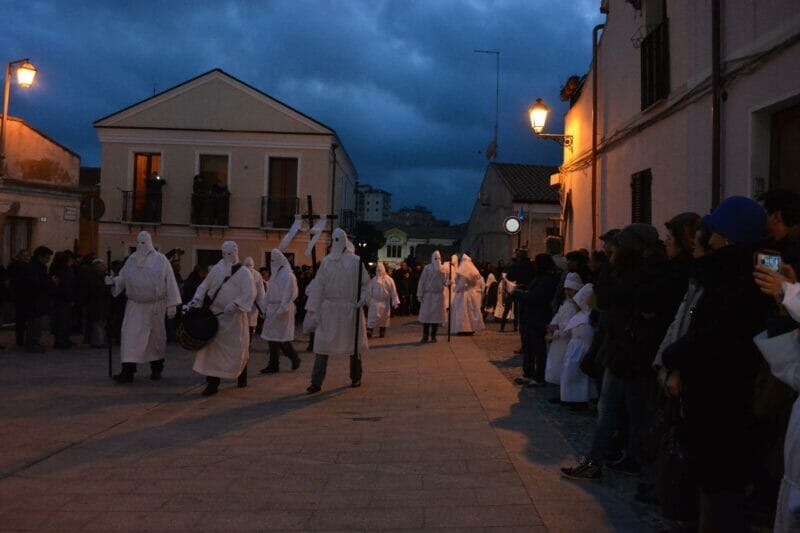
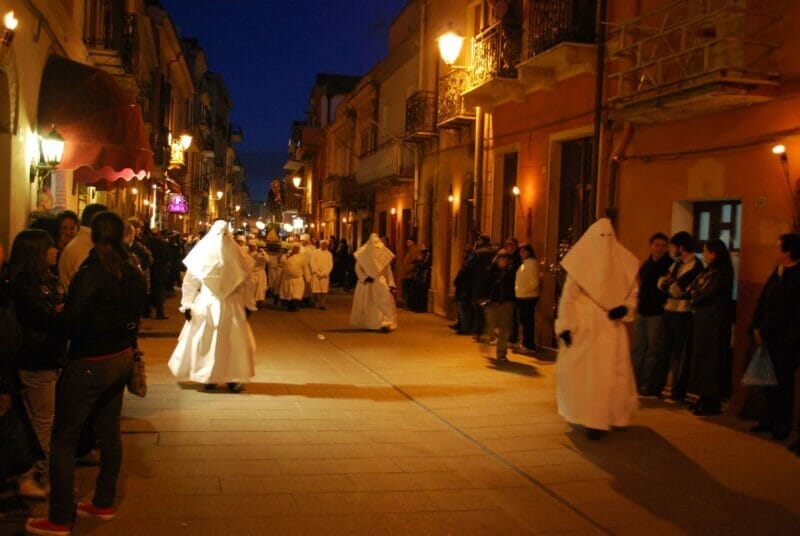
One of the most typical symbols of these rites are the Germani (a word that comes from the Spanish hermanos, brothers). They dress up in white tunics, cover their head and face, and take part in the processions in the exact same way as in some parts of Spain.
Walking along the processions there are the Babballottis, men dressed in slightly different white tunics (in this case, the tunic is soft and not rigid) who have an active role as they carry the statues and other symbols.
The Misteri procession takes place on Tuesday and the details differentiating it from other Misteri rites are, once again, the Spanish origins. The litter carrying Christ’s statue is decorated with an olive branch and Mediterranean herbs (bay, rosemary, and lavender). This will receive the priest’s blessing and will be given away to worshippers on the next day.
On Thursday, the Germani hold another procession representing Mary’s research for her son throughout the whole city and, on Friday, there is a reenactment of Jesus climbing the Calvary hill. S’iscravamentu takes place privately within the Confraternita members.
On Saturday night, they carry the statue representing Christ resurrected to the Cathedral. Then, on Sunday morning, the traditional S’Incontru processions meet, bow three times, and join together for the Holy Mass.

Santu Lussurgiu
The week before Palm Sunday is already busy in Santu Lussurgiu. In fact, all the palm branches need to be manually weaved. Besides, the people in charge of the holy songs have to rehearse all week.
The first, big event is the Nazarenu held on Tuesday. It’s a shorter version of the Via Crucis that goes through all the city.
Wednesday is for preparations for the following day. On Thursday, in fact, they will hold the Lavanda dei Piedi (Washing of the Feet), the Maria Addolorata procession (Mary’s search for Jesus), and the Incravamentu, the crucifixion’s reenactment accompanied by a litany called by the locals the Miserere Longo (Long Miserere) because of its duration.
The day after, on Friday, they hold one of the most beautiful S’Iscravamentu rites in Sardinia. The preparation, the procession, the various phases of Christ’s deposition from the cross are all accompanied by very dramatic, narrative songs. They are truly moving.
Saturday is again a day of preparations. The two simulacra of Mary and Jesus are decorated and ready to be carried around on Sunday, during the usual S’Incontru processions.

Alghero
Alghero’s Easter rites are, like Iglesias’ ones, still highly influenced by the Spanish, more precisely, by the Catalan. The celebrations start with the Misteri Procession on Tuesday. On that day, people carry around the six statues representing various episodes of Christ’s Passion – they don’t use litters.
On Thursday, two different rites take place. One is Las Cerques, Mary’s frantic search for her son. The procession accompanies her to every church in Alghero and back to the Misericordia Church where they started. The other is the Arborament, Jesus’ Crucifixion.
After this last rite, the statue will be venerated in a constant, nonstop watch that will go on until the end of Friday.
On the late evening of Friday, after the Messa Fugi Fugi, they take the simulacrum to Santa Maria Church where the members of the local Confraternita will perform the deposition. They call it “Desclavament” here. In Alghero, the coffin that carries Jesus’ body is entirely in gold. This shows the city’s ancient wealth.
The rites finish with the usual Sunday processions, S’incontru. Every church’s bell rings in celebration. There’s also a Holy Mass in Catalan.
Make sure to read my other posts about Alghero:
Final Considerations About Easter In Sardinia
I hope I managed to entertain you with this summary of Easter rites in Sardinia! This is only a very brief description of a much bigger, extended tradition. Almost every city on the island has its own small variations in the Easter rites, and it would be impossible to describe them all.
Pin It For Later!

Claudia Tavani
Claudia Tavani was born and raised in Sardinia, and after moving between the United States and the United Kingdom, she's now back living in her hometown, Cagliari. She's a travel blogger and certified travel designer who loves planning trips and publishing guides, travel tips, and packing lists so that you don't have to. Owner of Strictly Sardinia, cat mom to Minnie. Loves pizza, hiking, archeology, cities, beaches, swimming, and running. Hates peppers.