
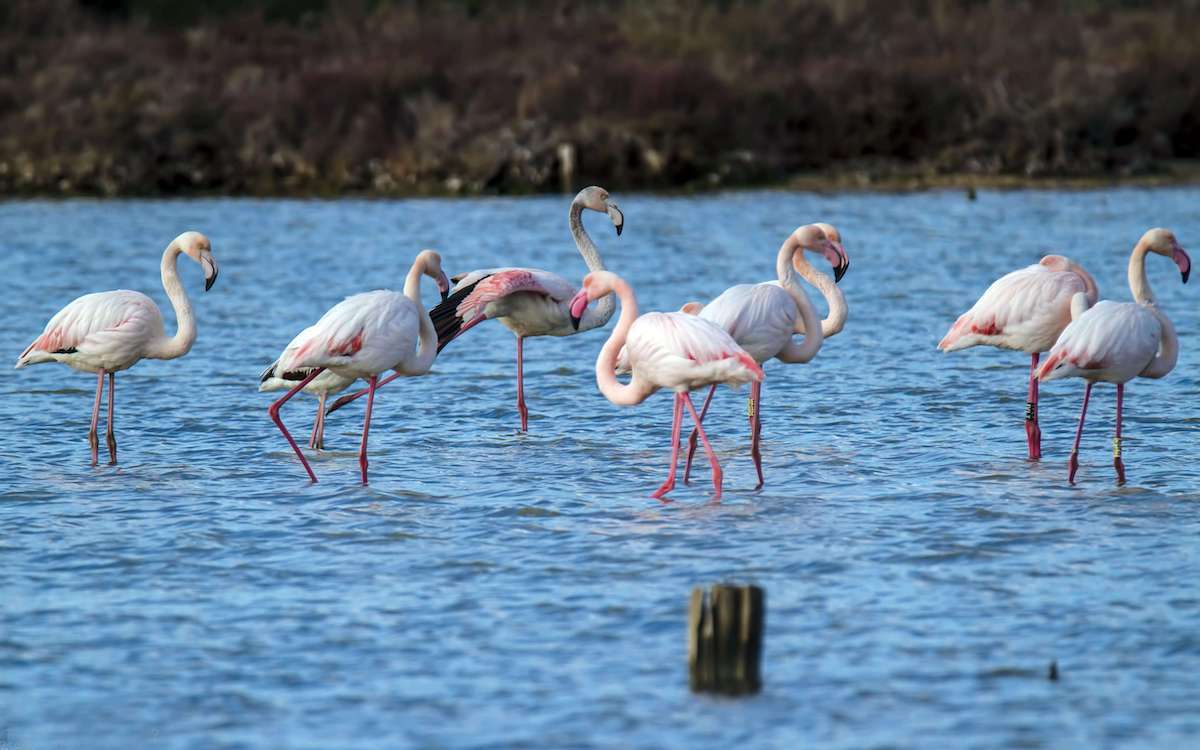
We love pink flamingos in Sardinia. Somehow, they have become a symbol of the island. They are part of the landscape of Cagliari, where they officially established themselves in 1993 (though many will tell you that they could be seen before too).
You can see them in the wetlands that surround the city. You can see them flying from one side of the city to the other around sunset time, pretty much every day, in Cagliari.
Appreciated for their elegance and representing positivity since ancient Egypt, here we call them “genti arrubia” (red people).
To me, they also represent freedom. I still remember how I got goosebumps and teary eyes when – finally allowed to get out at the time of the pandemic – I caught a glimpse of them flying on the skies of Cagliari. I had missed seeing them so much!
If you are planning a trip to Sardinia and want to observe these birds in their natural habitat, then you may find this guide very useful.
Keep in mind that flamingos are very shy, so they will not hesitate to flee if disturbed. Therefore, it is better to observe them from a distance, possibly from dedicated birdwatching spots or during birdwatching tours.
You can bring binoculars with you for birdwatching so that you can see the flamingos up close.

Where To See Flamingos In Sardinia
Before I share my favorite places to see flamingos on the island, I need to point out that this is just a small selection, and that there are indeed many more places where you may be lucky to see them.
In recent weeks, I spotted a few pink flamingos in Marceddì Lagoon, not far from Oristano, and in the lagoon at the back of the wonderful Porto Pino beach in South Sardinia. This is to say that it doesn’t really take much of an effort to observe these beautiful birds.
Having said that, let’s look at the best spots where you can see flamingos around Sardinia.
Molentargius Nature Park, Cagliari
Recent research shows that the Parco Naturale di Molentargius (Molentargius Nature Park) has the largest flamingo colony in Italy, with over 8,000 specimens.
The Parco Naturale Molentargius is one of the most important wetlands in Europe and one of the best (and easiest) places to see flamingos in Sardinia. You will find this pond near the metropolitan area of Cagliari and was used for salt mining until 1985. Currently, the reserve is home to many species of birds, including flamingos.
In recent years, the Molentargius pond has become one of the most important places in the Mediterranean for the nesting of these beautiful animals.
The area is divided into two systems, with the Perdalonga and the Bellarossa Minore as fresh water ponds. The Bellarossa major, the Pedrabianca and other areas categorized as salt water. The Is Arenas fossil plain divides the two systems.

There are several ways to visit the Molentargius Nature Park – it’s free to access and you can explore independently. Usually I recommend to book a guided tour, to discover the best locations for observing flamingos, as well as other bird species in the area, such as the sultan chicken.
There are all sorts of tours, which usually depart from the Marina District of Cagliari. You have the option of booking segway tours, bike and even electric bike tours, and the park also operates an electric bus tour.
Only certified guides can take people around Molentargius – the park has strict regulations. So you know that you will be getting an experienced guide for your birdwatching experience.
During the tour, you can admire the Salt City, and then move on to the naturalistic area where you can see pink flamingos in their natural environment.

These are the tours I recommend the most:
Guided Bike Tour in the Flamingo Oasis – This 2-hour bike tour is one of the best tours of Molentargius Nature Reserve.
Molentargius Natural Park Segway Tour with Coffee – The main difference between this tour and the one above is the fact that you will be traveling by segway.
You can get to Molentargius by bus from Cagliari city center. There are various entrances to the Natural Reserve, the most convenient to reach by bus is the one on Lungomare Poetto. Hop on bus P from Piazza Matteotti and get off at Ospedale Marino. It’s a short walk from there to the gate.
My post A Complete Guide To Visiting Molentargius Nature Reserve will give you more tips to plan your visit.

Stagno di Cagliari
The Stagno di Cagliari, also known as Stagno di Santa Gilla, is a lagoon of great importance located near the city. It is a 1,300-acre wetland area with great biodiversity and two-and-a-half meters deep water, which is partly salty and partly fresh due to its confluence with rivers.
Among the two hundred species of birds, Cagliari Pond is a favorite nesting place for flamingos. It is possible to observe them from the dedicated birdwatching stations located along the highway.
To get to the Stagno di Cagliari by car, you can take the SS131 following the signs to Via Caduti di Nassirya a Elmas and then drive until you reach your destination.

Su Stani Saliu, Serdiana
You will find Su Stani Saliu in Serdiana. The name literally means “the salted pond. This is a small pond characterized by brackish waters, with an area of about 23 hectares and a depth of almost 2 meters.
I did not know there were pink flamingos in the area until my mom – who is from Serdiana – told me about them so I went to check them out. It’s a lovely place, pleasant for a walk in the countryside and a completely hidden gem of Sardinia.
The banks of the pond have rushes and coral grass, typical of marsh waters. In spring and autumn, environmental conditions favor the proliferation of various species, including flamingos.
Serdiana is around a 30-minute drive from Cagliari. You will have to travel east on the SS554 and turn left onto SS387 towards Dolianova. Once you are in Serdiana, follow the Via Roma (it’s actually the main road), then turn left to Via Arrocchedas and drive until you get to the pond.

Chia Lagoon, Domus de Maria
Chia is a wonderful place to visit at easy driving distance from Cagliari. Su Giudeu, one of the most famous Chia Beaches, is a long beach of golden sand, backed by beautiful (and highly protected) sand dunes and Mediterranean bush.
At the back to the beach, the Chia Lagoon (Stagno di Chia, in Italian) is an excellent spot to admire pink flamingos. One thing to keep in mind is that this pond normally evaporates with the heat of the summer, so for better chances of seeing flamingos here, plan to visit in the spring.
It takes about one hour to drive to Chia from Cagliari. You will have to follow SS 195 to Pula and drive towards Domus de Maria. A sign on the left will point you to the beaches of Chia. Follow the sign to Su Giudeu.

Stagno di Notteri, Villasimius
Notteri Pond, located near Villasimius, is the ideal place for those who want to combine a day at a beautiful beach (Porto Giunco) with birdwatching. The strip of sand, called the Giunco separates the sea from the lagoon, the latter a habitat for flamingos.
This particular division has made Notteri Pond the ideal place to shoot commercials and films. Nestled in the Mediterranean maquis, the pond is one of the most relaxing places to see flamingos in Sardinia, as it is perfect for families and for those who prefer relax to exploration.
The best way to get to the Stagno di Notteri is by car. From Villasimius (about one hour east of Cagliari) you need to take Via Umberto I and then Via del Mare. Follow the road and then take Via degli Oleandri to get to the lagoon.

Laguna Mistras, Cabras
Located near the Gulf of Oristano in the Sinis Peninsula, on the west coast of Sardinia, the Cabras pond joins Mistras, Pauli ‘e Sali and Sal’e Porcus to form one of the largest wetlands in Europe.
The Mistras Lagoon has a “duck” shape, clearly visible from above. And indeed, the pond is a favorite among birdwatchers, as it is home to the flamingo and to other species such as the marsh harrier and the herring gull.
The area is also popular for fishing and hiking, with a wealth of marine wildlife and an area to explore either by mountain bike or sailboat.
You can only access the lagoon via guided tours run by ALEA, a local company that places a lot of focus on sustainability. You will explore the lagoon on a kayak. You can see the tours they offer on their website and get in touch via email at [email protected].
Not far from Cabras, you can also see pink flamingos in Marceddì Lagoon.

Stagno di San Teodoro
Surrounded by typical Mediterranean scrub, the Stagno di San Teodoro is a lagoon located behind La Cinta Beach in San Teodoro (that’s one of the most beautiful Olbia beaches). The lagoon has been arranged with paths and fences, from which you can admire pink flamingos and other animal species.
If you are planning your visit to Sardinia in September, you might take the opportunity to participate in the festival dedicated to this lagoon, with excursions, boat and bike tours, as well as tastings of local products.
You can get to the pond from San Teodoro, located on the northeastern coast of Sardinia (not far from Olbia) by car. Take Via Antonio Gramsci and then the SS125 Orientale Sarda.

FAQs On Spotting Flamingos In Sardinia
Bird watching tours in Sardinia
You really don’t need to go on a tour to see flamingos in Sardinia, but it may be a good idea to join one if you want to learn a bit more about their life, habits, and their connection to the island.
During bird watching tours, you will have plenty of photo opportunities – however, make sure to bring a long lens as flamingos in Sardinia are protected and you will need to keep a safe distance from them, and stay on the marked trails – this is both for your safety, and that of the birds.
The majority of bird watching tours in Sardinia are offered in Cagliari and go to Molentargius Nature Reserve, as this is a prime place to spot flamingos in Sardinia.
These are the best tours:
Guided Bike Tour in the Flamingo Oasis – This 2 hours bike tour will have you hop on a bike from the Marina historic district. From there, you will make your way to Molentargius Nature Reserve. On the way, you will also see the beautiful Basilica di Bonaria.
Molentargius Natural Park Segway Tour with Coffee – This tour is actually very similar to the one above. The main difference is the means of transport, which is a lot of fun!
Electric Bike Nature Tour – For this tour, you will be riding an electric bike around the Molentargius Nature Park. It’s a better option if you are not too confident on a bike.

What kind of flamingos live in Sardinia?
The flamingos that live in Sardinia are the “Phoenicopterus roseus”. They have a white-pink plumage, a pink beak with a black tip, a very long neck and long legs (they are 130 cm / 4.2 feet tall) and yellow eyes. They have a wingspan that can go up to 180 cm (5.9 feet).
Are pink flamingos from Sardina?
Pink flamingoes are not originally from Sardinia, but they have been seen on the island for centuries. Pliny the Elder mentioned spotting pink flamingoes in Sardinia in his “Naturalis Historia”, which he wrote between 77 and 78 AD.
However, it’s been since the 1990s that pink flamingos starting nesting in Sardinia. The population has increased since then, and we locals are very accustomed to see them flying in our skies, especially at sunset, in beautiful formations.
Why are pink flamingos pink?
Pink flamingos are not actually pink when they are born. Chicks are actually grey!
The typical pink color of their feathers is caused by a pigment – canthaxanthin – which they literally eat as they feed on brine shrimp and algae rich in artemia salina, which on the other hand is rich in carotenoids, red-orange pigments.
Depending on the flamingos, the color is actually a really pale pink which is due to preening.

How long do pink flamingos live?
First of all, there is a massive difference in the lifespan of flamingos that live in captivity and those that live in the wild. Flamings in captivity live up to 50 years; whereas those in the wild can live between 20 and 30 years, depending on the environment, their diet, and their exposure to predators.
The life of pink flamingos in Sardinia
Here in Sardinia, we are really used at observing flamingos.
They live in colonies, preferring brackish coastal and inland waters. They usually build their nests on muddy material, on embankments and islets, laying eggs in May and June.
One thing you will immediately notice when you see them is that they often keep their head under water. That’s because they are feeding!
They use their long beak to separate the mud and silica from the food and find molluscs and crustaceans that they feed on. What’s incredible is that they actually eat with their head upside down.
Another interesting thing to know is that pink flamingos are monogamus, and both males and females contribute to the hatching and to the feeding of their chicks.
Finally, you will often see flamingos standing on just one leg. Some researchers say that they do this to regulate their body temperature.

How do pink flamingos sound?
The sound of pink flamingos is unique – though they are not nearly as loud as other birds. Here in Sardinia, we are accustomed to hearing them honking, growling and grunting – especially when they are feeding or courting.
Best season to see flamingos in Sardinia
It’s important to know that flamingos are migratory birds. In general, it is possible to find flamingos in Sardinia throughout the year, even in winter.
However, the best time to see flamingos in Sardinia is in the late spring months, when they return to the island after the winter migration, and especially in the first weeks of June, as they gather for mating and nesting.
If you are visiting the island for birdwatching, this is the best time to visit (in fact, it’s one of the best seasons to visit Sardinia altogether!).
Having said that, you can still spot flamingoes well into the peak summer months and even in early fall – my friend visited in October and we specifically went to see flamingos in Molentargius and we spotted loads. In fact, this is when they prepare for the winter migration.
If you visit Sardinia in the winter, you will see be able to see flamingos. Of course, there aren’t as many as during the spring and fall months, but they can certainly be spotted in some specific places.
For example, I see them all the time in the inner bits of Molentargius Nature Reserve as I drive along the Asse Mediano (a freeway that cuts through the city of Cagliari).

Best time of day to see flamingos in Sardinia
Let me clarify that you can see flamingos throughout the day. However, they are usually more active in the coolest hours of the day – in the early morning and closer to sunset time.
Comes sunset time in Cagliari during the summer months, and not a day goes by without seeing flamingos flying from one lagoon to the other!
Final Considerations
Sardinia will never cease to amaze you. While most people come here looking for its gorgeous beaches, it doesn’t take them long to realize that the island has so much more to offer.
There’s something for everyone, and adventure travelers and nature enthusiasts – including birdwatchers – will not be disappointed by the incredible offer of activities and attractions.
Pin It For Later!


Claudia Tavani
Claudia Tavani was born and raised in Sardinia, and after moving between the United States and the United Kingdom, she's now back living in her hometown, Cagliari. She's a travel blogger and certified travel designer who loves planning trips and publishing guides, travel tips, and packing lists so that you don't have to. Owner of Strictly Sardinia, cat mom to Minnie. Loves pizza, hiking, archeology, cities, beaches, swimming, and running. Hates peppers.