
Are you wondering “what are the best beach towns in Sardinia?” – then you are in the right place. I am a local and I will share the best picks.
I always say Sardinia is the most beautiful island in the world, and it’s not just because I was born and raised here. I have traveled to many places around the world and I have yet to visit somewhere that wows me the same way Sardinia does. Being an island, of course there are so many pretty beach towns in Sardinia.
Coastal towns in Sardinia have all shapes and forms: hilltop villages like Castelsardo; pristine clear waters like La Pelosa; colorful alleys like Carloforte or whitewashed buildings like Calasetta. But they all have one thing in common: they are right by the sea, so no matter which one you pick, you’ll be within easy distance from an amazing beach.
If you are planning a trip to Sardinia in the summer, chances are you want to base yourself in one of the beach towns in Sardinia to explore the best Sardinian beaches. Don’t worry if you don’t know which place is right for you. I have selected the nicest seaside villages in Sardinia, and for each I will share the best activities and beaches.
Read on to discover the best Sardinia beach towns from the west coast to the north, east and south.
My post The Prettiest Towns And Cities In Sardinia includes a larger selection of places, not necessarily by the beach but definitely worth visiting.

The Best Beach Towns In Sardinia
Bosa
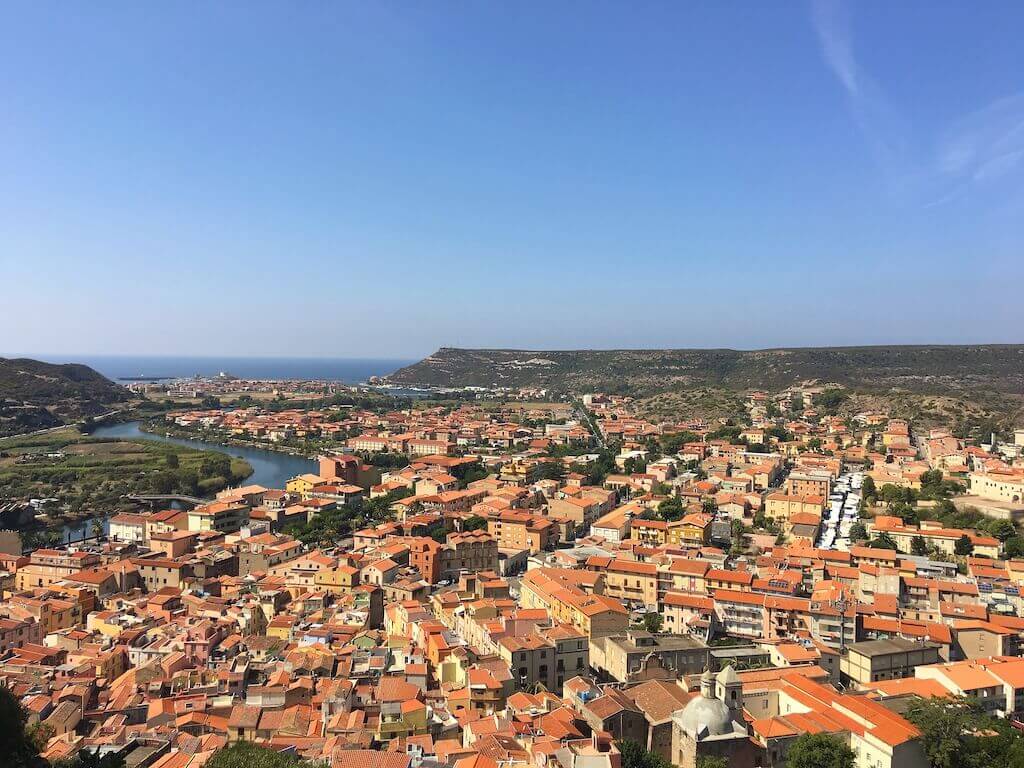
I always say that Bosa is my favorite small town in Sardinia, and while the beaches in the area aren’t perhaps as impressive as those in other parts of the island, it remains one of the best beach towns in Sardinia – and certainly the most scenic (though granted, it sits about 3 km – 1.8 miles) inland.
Bosa is located on the western coast of the island, on the banks of the Temo river and about one hour drive from Alghero, along a very scenic road. It’s historic center is a maze of narrow alleys and very colorful buildings that make it a fantastic place to photograph – and that’s why it is regularly mentioned among the Borghi Più Belli d’Italia (Most Beautiful Villages in Italy).

The main attraction in Bosa is the Malaspina Castle, built between the 12th and 13th century on the Serravalle Hill overlooking the village. It’s a fantastic vantage point for breathtaking views of Bosa, and inside you will find the beautifully frescoed 9th century chapel of Our Lady of the Regnos Altos.
The nearest beach is that of Bosa Marina, which is easy to reach by bike from town. It’s a dark, volcanic sand beach. My favorite nearby beach is Cala Cumpultittu, and the best swimming spot is Cane Malu (it literally translates as “bad dog”), which is however unsuitable on windy days.
Make sure to read my Guide To The Best Things To Do In Bosa for more ideas and tips on what to see and do.

Alghero
Just north of Bosa, on the northwestern coast of Sardinia, Alghero is one of the most popular tourist destinations in Sardinia. It has an airport, which means it’s very easy to reach year-round via a number of regular flights from mainland Italy, and lots of low-cost flights from other places in Europe. And it has lots of excellent hotels.
I know Alghero really well – when my sister lived in Sassari, I’d visit her on a regular basis and since Alghero is just a 30-minutes drive, we’d always go there.
Alghero is a one-of-a-kind place even in Sardinia, as it has Catalan roots. In fact, Catalan is the main language spoken here.
The city is surrounded by ramparts – the Bastioni – which are the perfect place for a late afternoon walk to catch one of the most beautiful sunsets in Sardinia. Excellent restaurants abound – for all budgets.
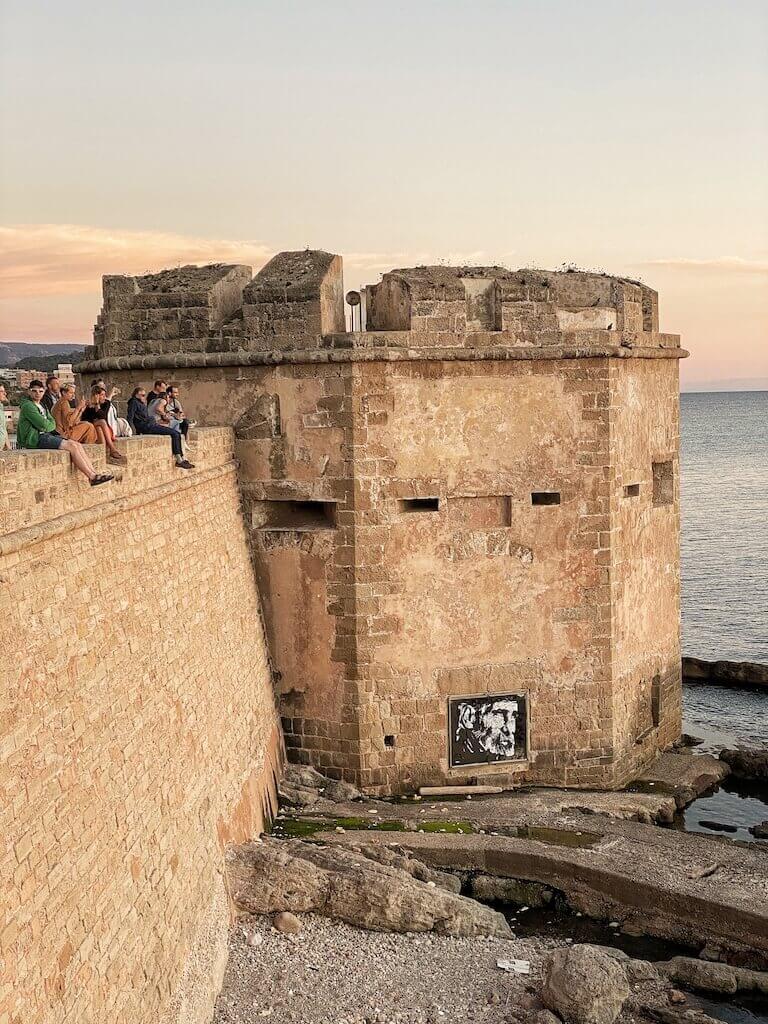
Piazza Civica is the main gathering point, but the main attractions (other than the bastions) are the Cathedral and its bell tower, the Torre di Porta Terra and obviously the beaches – the main ones are Maria Pia and San Giovanni, which you can reach via a walk along Via Lido, Alghero’s waterfront.
Close to Alghero, attractions abound. First of all, there’s Nuraghe Palmavera, one of the best preserved nuraghe in Sardinia. You can visit with a combined ticket that will also allow you to access Anghelu Ruju Necropolis. In front of that, Sella e Mosca is the largest winery in Sardinia (and offers fantastic wine tasting tours).
A short drive from Alghero will take you to Capo Caccia, a fantastic panoramic point where the Escala del Cabirol staircase offers a good workout and even more impressive views, and takes you to the Neptunes Grotto, which can be visited on a guided tour.
I have written extensively about Alghero, but my post A Perfect Itinerary For A Long Weekend In Alghero is the most useful to plan your visit.

Stintino
Stintino is one of the newest coastal towns in Sardinia. Overlooking the Gulf of Asinara, the village was founded in 1885 when the inhabitants of the Island of Asinara were forced to relocate as a penal and leper colony was going to be placed there.
Most people visit Stintino to enjoy its beaches. The most famous is La Pelosa, a picture-perfect beach known to be one of the most beautiful beaches in the world, and one of the protected beaches of Sardinia. The beach has incredibly clear, shallow waters and is surmounted by an Aragonese watchtower (Torre della Pelosa).
There are many more beaches to visit in Stintino – Ezzi Mannu, le Saline and Pazzona just to name a few.
In the village, you can visit the Museo della Tonnara to learn about the mattanza technique used to catch these large fish.
Stintino is a great starting point to visit Asinara Island. You can also hop on a quick ferry ride to Fornelli, one of the small harbors in Asinara, or join a sailboat tour such as this one to visit Asinara National Park – it includes lunch and snorkeling equipment.
My Stintino Guide guides you to more beaches and activities in the area.

Castelsardo
Castelsardo is another beautiful coastal town in Sardinia that, interestingly, doesn’t really have much of a beach but just small coves. I have been there many times – I remember when my friend Chrysoula from Greece visited she fell in love with it instantly, and last summer my friends and I used it as a base to explore the beaches of the nearby Costa Paradiso.
The colorful Castelsardo is perched on a promontory overlooking the Gulf of Asinara and dominated by the Doria Castle – one of the most famous castles in Sardinia, currently housing the Museo dell’Intreccio Mediterraneo and a fantastic place for panoramic views.

Another great place to visit is the Concattedrale di Sant’Antonio Abate (the new cathedral), which is incredibly located on the side of the hill and directly overlooking the sea. It houses frescoes painted by Andrea Lusso and an 18th century pipe organ. There’s also a crypt you can visit and a bell tower right next to it.
If you are looking for a beach, head to La Marina or to Lu Bagnu. They are small but pretty. Or you can also drive to the nearby Costa Paradiso for more choice.
And don’t forget to book a table at Il Cormorano – it’s one of my favorite restaurants in Sardinia.
Head over to my post A Useful Guide To Castelsardo for more tips on places to visit in and near the village.

Santa Teresa di Gallura
Located in the northeastern tip of Sardinia on the Strait of Bonifacio, Santa Teresa di Gallura is a truly lovely place that works as an excellent base to explore northern Sardinia – there are some great places to stay in Santa Teresa.
Its location makes it easy to reach Palau, which is only 30 minutes away by car, and from there explore La Maddalena Archipelago (though there are boat tours that depart directly from Santa Teresa).
But you can even go on boat tours that explore the islands off the southern coast of Corsica, such as Lavezzi and Ile Piana – or just catch a ferry to Corsica.
The center of town is the Piazza Vittorio Emanuele, where you’ll find restaurants and bars. Make sure to also visit the 16th century Longosardo Tower, a great panoramic point from where you can admire the Rena Bianca beach below (this is the main town’s beach) and Corsica too.

Nearby, you can go for a walk in Capo Testa to admire the rock formations and the lighthouse, or visit the more secluded Cala Spinosa Beach (there’s a bit of a hike to get there).
The Valle della Luna (Moon Valley) is only 4 km (2.5 miles) from town. This is one of the most popular sunset spots in Sardinia and a bit of a hippies hub – it’s also one of the locations of the Musica Sulle Bocche jazz festival that takes place every summer.
If you are looking for a long, sandy beach perfect for the whole family, head to Rena Majori – it’s an easy 15 minutes drive.
Don’t forget to read my Useful Guide To Santa Teresa Di Gallura and Complete Guide To Gallura for more information on attractions in the region.

Palau
Founded in 1875 by local shepherds, Palau was a hamlet of the larger (and inland) Tempio Pausania municipality until 1959, but now it is one of the most famous seaside villages in Sardinia.
Most people stay there as it’s an easy base for boat tours of La Maddalena Archipelago, and it’s also quite close (just 30 minutes drive) from the famous Emerald Coast of Sardinia. But I can assure you it’s a beautiful place to spend a few days exploring, enjoying the many local beaches and the great restaurants.
The most famous landmark near Palau is the Roccia dell’Orso (it’s just 5 km/3.1 miles from Palau), a rock that’s been shaped to look like a bear by the rain and the strong winds that blog in the region. It sits on a panoramic point from where you can enjoy views of the coast. Not far from it you’ll find the ruins of the the 18th century Batteria Capo d’Orso military fort.
Another site worth visiting for history and archeology buffs is the Li Mizzani Giant’s Tomb, a funerary monument left by the nuragic civilization. In the past, it was thought that the tomb actually hosted gigantic creatures.
The most popular beach is Spiaggia della Sciumara – it has soft golden sand and clear waters, there’s a kiosk for food and drinks and a (paid) parking lot too.
Other beaches worth visiting include Cala di Trana, Cala Marinella and Cala Capra.
I recommend this catamaran tour of La Maddalena Archipelago from Palau. It includes lunch, drinks and the use of snorkeling gear too.
I have written A Guide To Palau that will share more useful tips to plan your visit.

La Maddalena
La Maddalena is the largest (and actually the only) town in La Maddalena Archipelago – where you will find the impressive La Maddalena National Park. Located in the Strait of Bonifacio, off the coast of northeastern Sardinia, this is one of the most beautiful places on earth. I visit almost every summer, and never tire of it.
Easy to reach by ferry from Palau, the town of La Maddalena is certainly pretty – picture narrow cobbled alleys, colorful buildings on the waterfront, and the typical small island vibe.
More than that, La Maddalena is where to stay in Sardinia if all you want to do is explore by boat – besides there are some excellent places to stay in La Maddalena.
Most people – and that would include myself – visit to enjoy the stunning beaches of the archipelago. Some of them, in Maddalena Island and in the nearby Caprera (connected by a causeway to Maddalena) can be reached by car – my favorite are Bassa Trinità in La Maddalena, and Cala Portese and Spiaggia del Relitto in Caprera.

Many other beaches can only be reached via a hike (for example, the stunning Cala Coticcio, Cala Brigantina and Cala Napoletana, all of them on Caprera Island). Others – in more remote island such as Spargi, Budelli or Santa Maria, are less accessible, and you will need a boat to get there.
But La Maddalena has more than just beaches to offer. If you enjoy hiking, there are plenty of trails to tackle. My favorite is the one that goes to Mount Teialone, where there are the ruins of a fort and from where you can enjoy beautiful views of Cala Coticcio below.
There’s also the trail that goes to Fortificazione Candeo, another abandoned fort that dates from the end of the 19th century. It’s right by a tiny cove that’s perfect for snorkeling.
You will find many posts on La Maddalena on this site, but if you only read one, I suggest my Complete Guide To La Maddalena as it includes everything you need to know.
I also have a post on the Best Boat Tours Of La Maddalena, but in case you don’t have time to read it I recommend this sailing boat tour of La Maddalena that departs from the tourist harbor of La Maddalena. It includes lunch and snorkeling equipment.

Porto Cervo
Let me start with a little disclaimer: I am not a fan of Porto Cervo. Any time friends visit and beg me to take them there, I try to explain what it is. They insist on going, so we go and the typical result I get is “this is it?!” – yes, that is it.
Porto Cervo is tiny (but there are some excellent hotels in Porto Cervo). It’s the heart of the Emerald Coast and it was built from scratch in the 1960s.
There isn’t much to it: it’s mostly massive villas perfectly hidden in the vegetation and where locals work as servants, gardeners, drivers. Other than that there’s a small center with luxury shops – known as Piazzetta – and a harbor where massive luxury yachts dock.
The best sight in town is the Stella Maris church by far. And of course there are all the beaches – Capriccioli (my personal favorite), Spiaggia del Principe, Piccolo and Grande Pevero and many more.
So, if I am not a fan, why am I including it in this selection? Because Porto Cervo is a bit like Disneyland. There’s really nothing Sardinian about it but it’s a magnet for VIPs and luxury travelers, so you may want to check it out anyways to see what all the talk is about.
Head over to my post The Best Guide To Sardinia’s Emerald Coast for more things to do and places to visit.

Loiri Porto San Paolo
Close to Olbia, on the northeastern coast of Sardinia, Loiri Porto San Paolo is a tiny place where very few people live throughout the year, but that swells up with tourists in the summer months. It’s a cute place with cafés, restaurants and shops, and there’s a nice marina too.
The main reason to spend time in Loiri Porto San Paolo is that it’s the best access point to two uninhabited islands that are absolute gems – Tavolara and Molara, part of the Marine Protected Area of Tavolara and Punta Coda Cavallo.
Tavolara is home to a beautiful beach. There used to be a tiny settlement here – in fact, history goes that this was one the smallest Kingdom in the world – and there’s still a restaurant on the island, called “Il Re di Tavolara” that is a testimony to that past.
There’s even a small cemetery and a (very tough) hiking trail that takes you to the peak, but I don’t recommend going without a guide because there are some parts that require abseiling.
Molara is even smaller. This is still a private island that in the past was used as a farm. You can still find the ruins of the farm, and a guided tour (the only way to visit) will take you on a hike to visit the main landmarks.
Needless to say, both islands offer fantastic snorkeling opportunities – for that, you are better off booking a guided tour such as this one that includes lunch and snorkeling equipment.
Not far from Loiri Porto San Paolo you will find more beautiful beaches to enjoy a relaxing day. My favorite is Porto Taverna.

San Teodoro
South of Loiri Porto San Paolo, San Teodoro is one of the most famous beach towns in Sardinia. Until 10 years ago or so, it was thought to be a valid alternative to the terribly expensive Porto Cervo, but having visited recently I have to say that San Teodoro really isn’t much of a budget place.
Yet, it’s a gorgeous place to be. The town is charming – there’s a main street with shops and restaurants, a night market where you’ll find souvenirs to take home, and a lagoon where pink flamingos live.
Much like for other coastal towns in Sardinia, the main charm of San Teodoro are the beaches (and there’s excellent accommodation in San Teodoro too).
La Cinta is the main town beach – a long, sandy beach with clear waters perfect for the whole family. Lu Impostu and Cala Brandinchi (which share the same parking lot) are the most famous ones. The are protected beaches and must be booked in advance.
Make sure to read my post What To See And Do In San Teodoro for more information on beaches and attractions in this lovely small town.

Orosei
Orosei is the small town in the valley of the Cedrino River, and gives its name to the Gulf of Orosei, which you may know as the Baunei Coast. Of course it’s one of several access points to the beautiful beaches of the Baunei Coast, but there’s more to it.
The town itself has a small but well preserved historic center, with the lovely Piazza del Popolo and the San Giacomo Maggiore Church, and a series of narrow alleys with colorful buildings.

While the Baunei Coast is famous for beaches such as Cala Goloritzé or Cala Luna, here I recommend visiting Cala Liberotto, Capo Comino (famous for its sand dunes) and the Oasi Bidderosa, a protected natural park where you’ll find a beautiful forest and series of pristine coves with clear waters and the finest, most powdery sand you can imagine.
Rent a kayak or join a guided bike tour to make the most of the area.
I have written a Complete Guide To The Baunei Coast that gives a great overview of everything the area has to offer.

Cala Gonone
Cala Gonone is located south of Orosei. It’s the beach hamlet of Dorgali, a lovely small town in the mountainous region of Sardinia. There’s really only one way to get to Cala Gonone (via Dorgali), so the feeling is that of a blissful isolation, though the town is bustling with visitors during the summer months.
What makes this a particularly popular place is the fact that it provides easy access to the beaches of the Baunei Coast (many boat tours depart from Cala Gonone), some of the best hiking trails in Sardinia and the Sea Oxen Grotto and the Grotta del Fico, among the most impressive caves in Sardinia.

Of course you can spend time at the Spiaggia Centrale and Spiaggia Palmasera, and you can also drive to the nearby Cala Fuili, the last beach of the Gulf of Orosei that can be reached by car. For all other beaches, you will need to hop on a boat or go on a hike.
For example, you can hike to Cala Luna: the trail starts in Cala Fuili and it’s mostly moderate, though I don’t recommend it in the heat of the summer as there isn’t much shade.
To visit as many beaches as possible, consider joining this boat tour of the Baunei Coast departing from Cala Gonone. It’s a dinghy tour, which means the boat moves a bit faster, allowing you to spend more time at the beach. I have also written a detailed guide on the Best Boat Tours From Cala Gonone that will be useful when looking into boat tours.
My Quick Guide To Cala Gonone highlights the best beaches in the area, and the best activities. I also have a guide on where to stay in Cala Gonone.

Santa Maria Navarrese
Santa Maria Navarrese is located on the southern end of the Gulf of Orosei, and it used to be (now it isn’t anymore) the beach hamlet of Baunei, a charming small town on the hills connected to Dorgali via a very windy road (when I drove it with my sister a few years ago, we had to take turns to drive as it was so bad we kept getting motion sickness!).
The town itself is very small – there’s a main road, a small harbor where tours to the Baunei Coast depart from, a square and some good hotels and restaurants. There’s an Aragonese watch tower and a nice church you can visit.

I love the main beach – Tancao. It’s backed by a beautiful forest of pine trees and it’s easy to access on foot from the village. Many don’t like it because water is immediately deep there, but that’s precisely what I love about it.
From Santa Maria Navarrese you can also drive to Baunei, and from there continue to the Golgo Plateau. It’s a nice area to visit in and of itself, but most go there as it’s where the trails to Cala Goloritzé, Cala Biriola, Cala Sisine and Cala Mariolu depart from. The nearby Perda Longa is where the Selvaggio Blu – a challenging 7-day coastal hike – departs from.
Of course, you can also reach these beaches by boat. I wrote a post about the Best Baunei Coast Boat Tours where I explain all the available options you can book.
You can rent a small zodiac to explore the Baunei Coast or, for ease, join a tour such as this one that departs from the harbor of Santa Maria Navarrese. Keep in mind lunch is not included.

Villasimius
Villasimius is my favorite beach town on the island. It’s about one hour drive from Cagliari, so you can go on a day trip from the capital if you wish – though I recommend spending more time if you can. But of course, if you want to stay there are some excellent hotels in Villasimius.
My parents own a holiday home in Costa Rei, a beach hamlet nearby, and until about 20 years ago the only road there was through Villasimius so of course we’d visit every time we went. And I still go, because it’s close to Costa Rei and because Villasimius beaches are stunning.
The town itself is pretty – a typical fishing village with a main street, colorful houses, a harbor where boat tours of the coast depart from, lots of good restaurants and gelaterie.
The main draw of Villasimius is once again the beaches – most of them are part of the Marine Protected Area of Capo Carbonara.

My favorite is by far Punta Molentis, one of Sardinia’s protected beaches and a real jewel (and swimming paradise) – it’s a typical stop during all boat tours along the southeastern coast of Sardinia.
Porto Sa Ruxi is another protected beach that must be booked in advance. It small but oh so pretty, and it never feels too crowded.
Then there’s Porto Giunco, which is a bigger beach with the clearest blue waters and really fine white sand. It’s dominated by an Aragonese watchtower which can be reached via an easy trail that departs from the end of the parking lot. The views from up there are magnificent.
I wrote many posts about Villasimius. If you read just one to help you plan your trip, make it this Complete Villasimius Guide By A Local.

Pula
Pula is another small coastal town that’s easy to visit on a day trip from Cagliari (though it’s also home to some of the best beach resorts in Sardinia), since it’s roughly 45 minutes away by car. The village is pretty, with colorful houses and a large main square home to nice bars and restaurants.
Located right by the sea in Pula you will find the ruins of the ancient city of Nora, one of the best preserved archeological sites of Sardinia, with beautiful Roman mosaics but also ruins that date from the Punic and Phoenician domination of Sardinia.
The beach close to Nora ruins is a popular spot among locals and tourists, and right behind it there’s a small church – Sant’Efisio Church – which plays a unique role during the Sant’Efisio celebrations of Cagliari between 1 and 4 May.

There’s also a lagoon where you can go for a walk, and where you’ll find Fradis Minoris, one of the best restaurants in Sardinia – also prized with a Michelin star. I’ve dined there and it’s a unique experience. I recommend booking a table in time to admire the sunset.
About 12 km (7.4 miles) from Pula, Santa Margherita di Pula is the town’s beach hub: there’s a beautiful beach and some of the best beach resorts in Sardinia.
My Short Pula Sardinia Guide will help you plan your visit to this lovely Sardinia beach town.

Sant’Antioco
Sant’Antioco is the main town on Sant’Antioco Island, the largest island off the southwestern coast of Sardinia, connected to the mainland via a causeway. It’s about one hour and 15 minutes drive from the city, but there’s so much to see and do on the island that I recommend to stay at least a couple of days.
Sant’Antioco used to be a Phoenician-Punic colony before becoming a Roman city later on in history. Roman ruins are scattered around the island, and the town is very scenic, with colorful buildings and a nice waterfront along which you’ll find good restaurants.
There’s also a museum of archeology and an ethnographic museum that are worth visiting.
Not far from Sant’Antioco, but on the other side of the island, there’s the Arco dei Baci, a fantastic panoramic point – you can descend to the water via a hiking trail. There’s no beach here, but it’s one of the most beautiful snorkeling spots in Sardinia.
I have a post A Useful Guide To Sant’Antioco Sardinia for more information on places to visit.

Calasetta
Another small town on the island of Sant’Antioco, Calasetta is completely different from any other place in Sardinia, and it is famous for its whitewashed buildings and colorful doors and windows.
Calasetta was founded in 1769 by around 40 families (coral fishermen) coming from the Tunisian island of Tabarka, where they had originally settled from Genoa, in northern Italy. This means that the culture, the language and even the food here are unique.

In town, you can visit the Museum of Contemporary Art, one of the best in Sardinia, and the local winery Cantina di Calasetta where you can go wine tasting. Make sure to also spot the Torre Sabauda, a tower dominating a beautiful beach easily accessible from the village, and known as Spiaggia Sottotorre.
An easy drive from Calasetta you will find the Mangiabarghe Lighthouse (Boat Eater in English), which is truly scenic especially on a strong mistral day, when the sea splashes on the rock formations with all its power.
Finally, Calasetta is one of the ports where you can catch the ferry to Carloforte.
Make sure to also read my post A Guide To Calasetta: you will find information on more things to do, and even places to stay.

Carloforte
My sister and I are so in love with Carloforte that we go at least once a year. The main town (well, the only really!) in San Pietro Island, Carloforte is accessible by ferry from Calasetta or Portovesme.
Its heritage is similar to that of Calasetta – it was created by a community coming from the island of Tabarka in Tunisia, and the Genoese heritage is indeed very similar. However, for as much as Calasetta is completely white, Carloforte is a real burst of colors.
Spend some time exploring the colorful alleys, some of them so narrow that cars can’t go through. Check out S’Archiottu, a nice arch in the historic center amidst colorful houses, and the City Walls and Lions Gate.

I recommend booking a guided tour of the Tonnare, to learn about tuna fishing – Carloforte’s past (and current) main trade. And of course, when in season (yes, tuna fishing is very seasonal) make sure to eat tuna at one of the many fabulous restaurants in town (I am a fan of Da Nicolo and Da Andrea).
Other places of interest are the lighthouse at Capo Sandalo, which can be reached by car, and the Nasca Natural Pools, located at the north of the island and where you can get via a hike.
San Pietro is also home to many beautiful beaches. La Bobba is a popular one, and well protected from the wind, and I also love la Caletta, which is on the northern coast of the island.
I have an Up-To-Date Guide To Carloforte And San Pietro Island which will prove particularly useful when planning your trip. I also have a guide on Carloforte hotels.

San Giovanni di Sinis
San Giovanni di Sinis is one of the lesser known beach towns in Sardinia that hardly get any foreign tourists, and yet one I truly enjoy. It’s located in the Sinis Peninsula, near Cabras and a mere 20 minutes drive from Oristano.
Small as it is, San Giovanni di Sinis is a real treasure chest with lots of interesting places to visit, and a wonderful beach (right in front of the village) with incredibly clear waters and beautiful rock formations. You can also reach the more famous beaches of Is Arutas and Mari Ermi, and opt for a boat tour to Malu Entu Island.

Make sure to visit the Church of San Giovanni – you can’t miss it, it’s the only one in the village. It dates from the 6th century and it’s one of the oldest in Sardinia. There are also the ruins of a necropolis that you can spot on a simple walk along the waterfront.
From San Giovanni you can also catch the train on wheels to the ruins of Tharros, another impressive site overlooking the sea where you can see example of Sardinia’s Roman, Punic, Phoenician and even nuragic heritage.
There aren’t many places to stay or restaurants in San Giovanni di Sinis, but you can opt to base yourself in Cabras for your holiday – the offer is excellent there.
My posts A Guide To San Giovanni Di Sinis and The Complete Guide To The Sinis Peninsula are the best local resources for this destination.
Map Of The Best Beach Towns In Sardinia
Wondering “where are the best beach towns in Sardinia?” – I have created a map to help you locate them. This will also give you an idea of the nearest airport to fly into.
How to use this best beach towns in Sardinia map: This map shows you the beach towns I have selected around the island. Use your mouse on desktop or laptop, or your fingers on your smartphone, in order to enlarge the map. Click on the star by the title of the map to save it into your account. You will then be able to see it by clicking on “Your saved maps” in Google Maps. To see a larger version click on “View larger map” at the top right corner.
Pin It For Later!



Grazie
Ottima guida complimenti e brava